
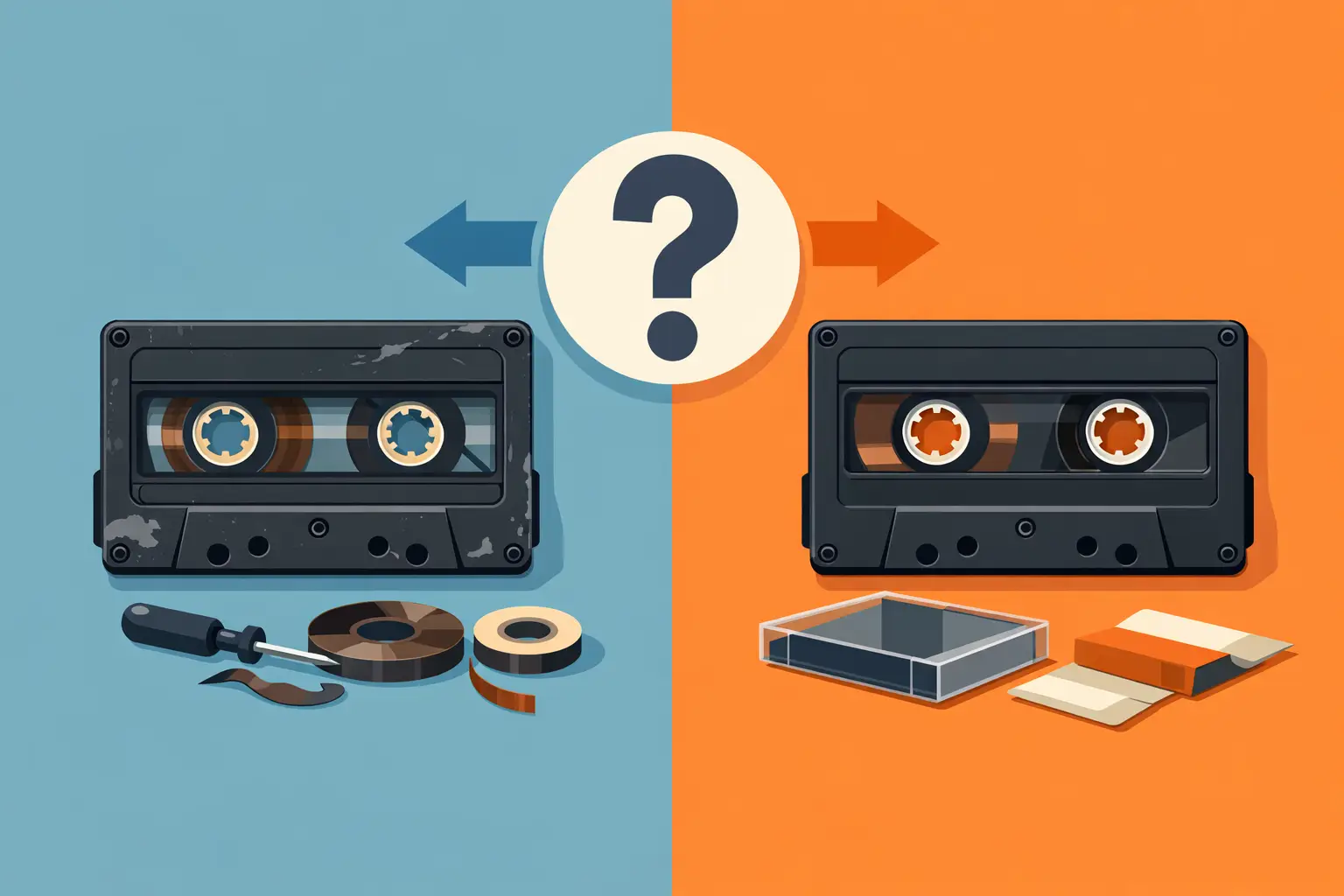
If you have ever stared at two reels that look equally promising and wondered why one is labeled refurbished while the other is NOS, you are asking the right question. In refurbished tape vs NOS, the better choice is not about which label sounds safer. It is about intended use, storage history, tape formulation, and how much uncertainty you are willing to accept.
For reel-to-reel users, this matters because tape is not a generic supply. It is the recording medium, the archive, and often the weakest link in the chain if chosen poorly. A great machine cannot rescue unstable tape, and an expensive tape purchase is not automatically a good one just because it is old and unused.
What refurbished tape and NOS actually mean
Refurbished tape is previously owned tape that has been evaluated, processed, and prepared for resale. Depending on the tape and seller standards, that can include inspection, respooling, cleaning, grading, leader replacement, and screening for obvious defects or problem stock. The key point is that refurbished tape has already lived a life, but it has also been handled with current scrutiny.
NOS means new old stock. The tape was never sold into regular use, or at least presents as unused, but it was manufactured years or decades ago. That makes NOS appealing to collectors and users who want period-correct stock, original packaging, or a tape that has not seen prior recording wear. It also means the tape may have spent a very long time in storage under conditions nobody can fully verify.
That distinction is where many buying decisions turn. Refurbished tape has history you can partly assess through inspection and grading. NOS has no use history, but it still has age history, and age matters.
Refurbished tape vs NOS for actual recording use
If your goal is to put tape on a machine and record with confidence, refurbished tape is often the more practical option. That may sound backward at first. Many buyers assume unused always beats used. In the reel-to-reel world, unused old tape can still suffer from age-related issues, binder breakdown, poor storage, edge damage from long-term tension, or formulation-specific failures.
A good refurbished reel has one major advantage: someone has handled it in the present day and judged it. If the seller has meaningful grading standards, you are not buying a theory. You are buying tape that has been screened for condition and categorized for expected performance.
NOS can still be excellent for recording, especially when it comes from a known stable formulation and has been stored well. But NOS is not immunity. A sealed box does not tell you whether the tape inside escaped heat, humidity, or chemical aging. Some tape families have known reputations, and those reputations matter more than whether the outer wrap is intact.
For users making fresh recordings, especially on machines that are already aligned for a certain class of tape, the decision usually comes down to reliability over romance. That tends to favor well-vetted refurbished stock unless the NOS tape is from a formulation with a strong track record.
Why NOS is attractive anyway
There are good reasons people seek NOS. For one, it can be ideal for collectors who value originality. If you are pairing period hardware with era-correct media, or preserving the full historical package of a format, NOS has obvious appeal.
Some buyers also prefer NOS because there is no concern about prior over-recording, mishandling, or undocumented machine wear. On paper, that sounds like the cleanest starting point. In reality, the tape’s condition still depends heavily on brand, formulation, and storage environment.
There is also a narrower use case where NOS makes strong sense for archivists and professionals trying to maintain consistency with legacy stock. If a project, collection, or workflow depends on a specific formulation, NOS may be the closest match available. Even then, it should be approached as aged media, not fresh factory product.
Where refurbished tape earns trust
Refurbished tape earns its place because inspection matters. In a niche where many products are decades old, current evaluation can be more useful than original status. A reel that has been checked, graded, and honestly described may be a lower-risk buy than a sealed reel with an unknown storage life.
This is especially true for users who want tape for routine playback, test recording, or non-critical studio use. A properly graded refurbished reel can deliver excellent value. It also opens the door to formats and widths that are harder to source in untouched condition.
That said, refurbished tape is not one single quality level. The seller’s process is everything. If there is no clear explanation of grading, no sign of technical knowledge, and no support policy, the word refurbished does not mean much. A specialist source with detailed performance standards and a replacement guarantee is a very different proposition from a random reel listed with vague claims.
The real variables are brand and formulation
The biggest mistake in refurbished tape vs NOS is treating all tape as equal once it falls into one of those two categories. It is not. Brand and formulation often matter more than the refurbished or NOS label.
Some formulations are known for aging gracefully. Others have a reputation for sticky-shed behavior, shedding, binder trouble, or inconsistent long-term stability. A great NOS reel from a problematic formula can be a worse bet than a refurbished reel from a more stable one. Likewise, a refurbished reel from a poor lineage does not become desirable just because it was recently inspected.
Experienced buyers usually start with compatibility and formulation history. Does the tape match the machine, the recording goal, and the expected performance level? Is the stock known for reliable archival behavior or mainly acceptable for casual use? Once those questions are answered, refurbished versus NOS becomes easier to judge.
Cost, scarcity, and how honest your use case is
NOS usually commands a premium. That premium is often justified by rarity, collector appeal, or the simple fact that untouched vintage inventory is finite. But paying more only makes sense if the benefits match your use case.
If you are laying down demos, testing transports, or making everyday recordings, paying a major premium for NOS may not improve your outcome. Refurbished tape can be the smarter allocation of budget, especially if you need multiple reels or a less common width.
If you are preserving a historically significant setup, building a collection, or seeking the cleanest possible original-stock example from a stable formula, NOS may absolutely be worth the extra cost. The mistake is assuming that expensive and unused automatically means better for every job.
This is where specialist inventory helps. A source with real depth can let you compare by width, brand, and condition instead of forcing a one-size-fits-all answer. That matters because a home hobbyist running quarter-inch stereo does not have the same buying logic as an archive sourcing one-inch tape for a specific machine family.
How to choose between refurbished tape and NOS
Start with the job. If the reel is meant for active recording and repeat use, prioritize condition screening, grading clarity, and formulation stability. That often points toward refurbished stock from a knowledgeable seller.
If the reel is meant for collection, historical matching, or a very specific legacy requirement, NOS becomes more attractive. Just remember that old stock is still old. Ask the same hard questions about formulation history and storage assumptions.
It also helps to think in terms of risk profile. Refurbished tape carries known prior use but may carry less mystery because someone has evaluated it recently. NOS carries no practical use history but often more uncertainty about decades of storage. Neither category is automatically safer. They simply fail in different ways.
For many buyers, the best answer is not choosing one category forever. It is using each category where it makes sense. NOS for select applications, collection goals, or exact stock matching. Refurbished for value, availability, and dependable day-to-day use.
A smarter way to read the label
The label tells you part of the story, not the whole story. Refurbished tells you the tape has been back in human hands and judged. NOS tells you the tape avoided prior use, but not time. In reel-to-reel, time is never a minor detail.
That is why seasoned buyers look past the headline term and ask better questions. What formulation is this? How was it graded? What defects were screened for? Is the seller transparent about performance expectations? Is there recourse if the tape does not perform as described?
At Reel to Reel Warehouse, that practical, formulation-aware approach is what helps buyers avoid the common trap of buying based on label appeal alone. The right reel is the one that fits your machine, your purpose, and your tolerance for age-related uncertainty.
If you treat refurbished tape vs NOS as a question of use case instead of status, you will make better tape decisions and probably spend your budget more wisely too.